
Do Their Eyes Hurt Too?
Observation is one of the keys to understanding wildlife behaviour. Sometimes, it is a tiny detail, something noticed almost by accident – that leaves us with the biggest question.
A mother snow leopard was feeding on a yak kill on the gorge below us. Even from where we stood, we could see the exposed bones gleaming against the landscape. She had three cubs, and each seemed to be doing something entirely different.
One was high above us, near the top of the mountain, its fluffy body silhouetted beautifully against the sunlight behind it. Another was far more energetic, sprinting and sliding through the snow as it made its way towards its mother. At one point, it stopped and looked towards the visitors. I would like to think it was looking at me!
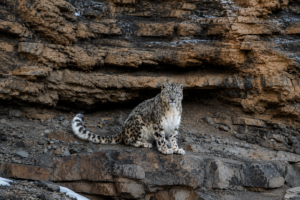
The third cub sat quietly on a rocky ledge, watching the world around it.
As I panned my camera from one cub to another, trying to observe their behaviour, I noticed something interesting.
The cub standing in the snow had crinkled its eyes until they were almost narrow slits. Yet the cub sitting on the rocky ledge had its eyes wide open – large and bright.
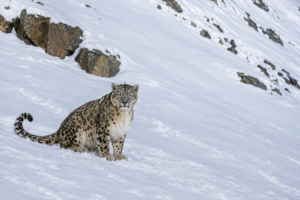
Why the difference?
Was the brilliant light reflecting off the snow uncomfortable for the first cub’s eyes?
The observation immediately took me back to something I had seen many years ago, high in the mountains of Nepal.
While taking their sheep and yaks out to graze, some local herders wore what looked like yak-hair goggles, made from loosely plaited strands of yak hair. The strands were placed across their eyes, with both ends tied behind their heads.
Curious, I had asked whether these unusual yak-hair goggles were part of their traditional dress or was it for some other reason.
Their answer fascinated me.
They explained that sunlight reflecting from the snow could become extremely uncomfortable for their eyes. After being exposed to the brightness, they sometimes found it difficult to see for a few moments when they entered a shaded place. The yak hair goggles reduced the glare while still allowing them to see through the gaps. They also believed the goggles helped protect their eyes from snow blindness.
Now, watching that snow leopard cub narrowing its eyes against the brilliant snow, I remembered those mountain herders and their simple yak-hair goggles.
We humans reach for sunglasses – often with UV protection – when the glare becomes too strong. Mountain people had found their own ingenious solution long before modern sunglasses reached these remote landscapes.
But what about the animals that have lived here for thousands of years?
Snow leopards are extraordinarily adapted to their high-altitude world. Their thick coats protect them from bitter cold and wrap their tail around them when the coldness it too nasty. In addition, their broad paws help them travel over snow, and their agile bodies allow them to negotiate seemingly impossible terrain.
But does the intense glare from snow affect their eyes too? Was this cub simply squinting naturally in bright light, or was it experiencing some of the same discomfort that makes humans shield their eyes?
One observation cannot give us the answer.
But it can make us ask the question.
Perhaps that is one of the joys of watching wildlife closely. The mountains may be the snow leopard’s home, and it may be superbly adapted to survive there, but even an animal perfectly suited to its environment must still respond to the sun, snow, wind and cold around it.
And sometimes, all it takes is one little snow leopard squinting in the snow to make us look more closely.